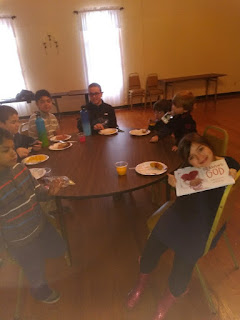
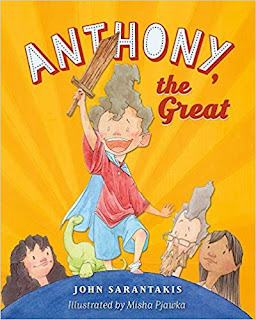
One of our Sunday school teachers read this with a group this week. We talked about how many people have no faith these days, and about how accessible this book makes God. I hope more people read it and are inspired.
First of all, don't ever tell me a picture book is "cute". A friend, (who had been on the Caldecott and Newbery Committees) who was the nicest librarian who ever lived, would get so angry when anyone dismissed a picture book as "cute"-- really people there are so many other words. There is so much depth and complexity in children's literature, at least their should be. Even Captain Underpants has a few different layers. Pictures books are a beautiful medium for authors and illustrators to share stories. They build visual literacy, have depth, and connect children to the world around them. Most teacher and parents use picture books as teaching tools with young people. For a book to be successful to me, it has to have a gel between the story and illustrations. It should have a flow between pages and as a whole work. Some of the best have a great theme and they should never patronize young people. That's Children's Literature 101 lesson A. Moving on...
I feel kind of silly to say that the reason I read this book was that John Irving said it was good. I picked it up out of a box of Advance Readers and remembered when it had first come out in the early 2010s. It won the E.B. White Read Aloud award in 2011 and it definitely would make a great read aloud for a seasoned teacher who can tackle some of the big issues mentioned in the book ( prejudice, death of a sibling, students being differently abled, bullying and more). The author also name drops a lot of fabulous books for kids so the Book Whisperer in me knows students would pick up on that and wonder about and maybe even read things like A Wrinkle in Time and Bridge to Terrebithia. I am glad I read it. And glad I found out the author knew John Irving because he's coached John Irving's s son in wrestling. https://www.google.com/amp/s/thebooknut.com/2011/02/13/10-questions-for-rob-buyea/amp/
The Wilderness Journal: 365 Days with the Philokalia Jason A. Gagnon Bringing it back to Earth January 16, 2019 Format: Paperback The Philokalia is a tricky set of books. It is a collection of writings from spiritual Fathers of the Eastern Christian tradition who lived and wrote between the fourth and fifth centuries. It often comes with a warning - "Don't read these without the guidance of a spiritual father!" They were written largely by monks for monks- but still, for a set of books called "Love of the Beautiful" that is strange advice. If these writings are to help the devout on the path to salvation, why do they so often come with a warning? To be fair, flipping through a volume of the Philokalia can sometimes read like the Eastern Christian equivalent of Zen Koans. What is the sound of one hand clapping? Beats me. But what about when St Isaiah the Solitary writes "He who receives no help when. at war should feel no confidence when at peace"? Be...



Comments
Post a Comment